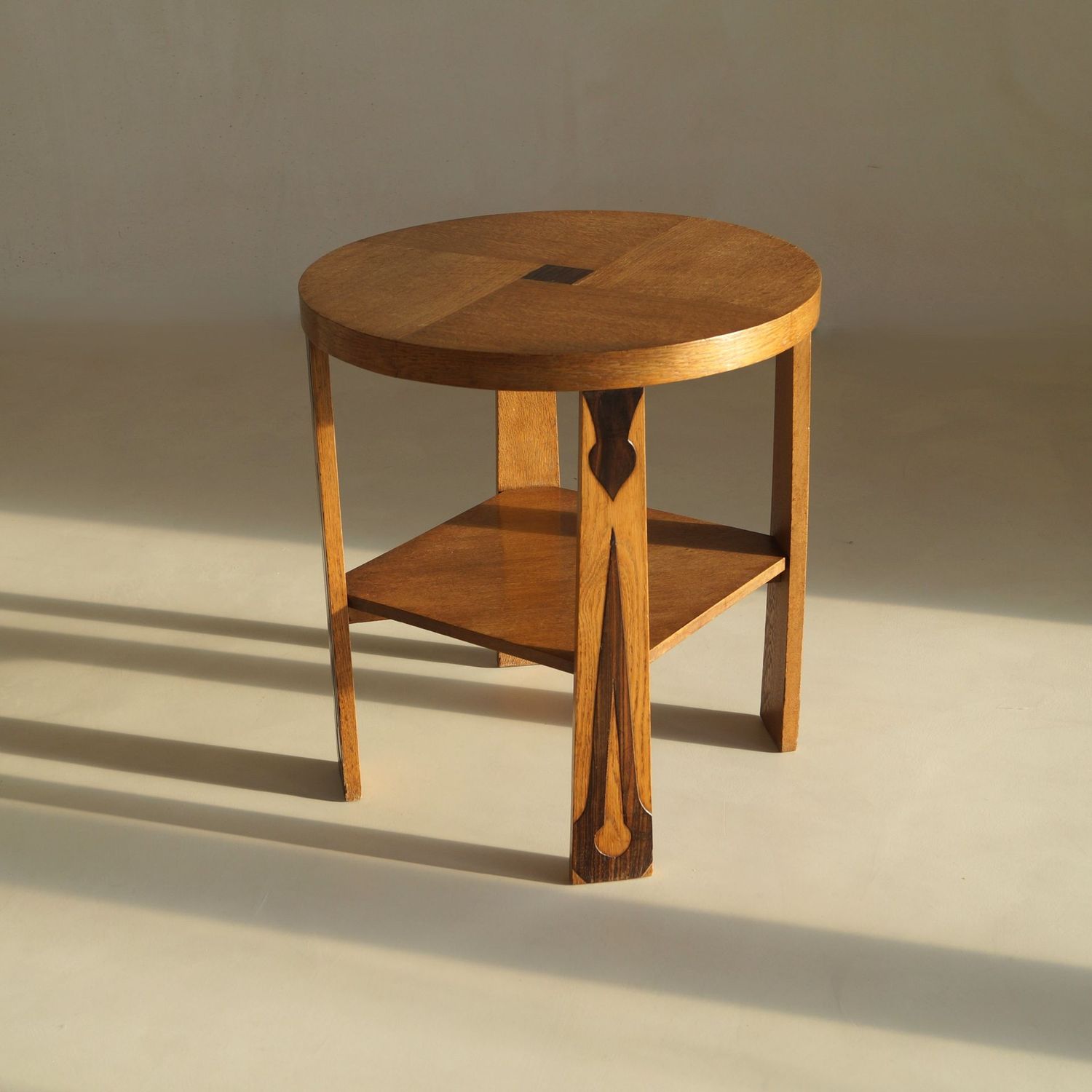
A Dutch 1920s occasional table in oak and macassar ebony (coromandel) details.
This piece is in very good professionally restored condition, heavier than one would expect and very sturdy and stable. The decorative motifs seen on the four tablelegs in macassar ebony are characteristic for the Amsterdam School style. The design may have been by P.E.L. Izeren for Genneper Molen.
''Amsterdam School'' is a collective name for the exuberant, imaginative and innovative design style from the period 1910-1930 by a diverse group of Dutch architects, interior designers and sculptors. Influential architects and designers include Michel De Klerk, Hildo Krop, Piet Kramer en J.M. van der Meij.
The Amsterdam School embodies several contradictions. It is an architecture that is instantly recognisable yet difficult to define. It celebrates the communal and the social yet gives almost infinite room for individual expression. It can look hyper-modern yet curiously medieval. And, at its most creative, it can be utterly, infectiously bizarre.
Amsterdam School architects designed a lot of exteriors and interiors in Amsterdam, but the style spreaded further all around the Netherlands. The Hague has its own variant, called The Hague School.
Creator
Unknown, possibly once sold by ''De Bijenkorf'' warehouse
Design Period
1920 to 1929
Production Period
1920s
Country of Manufacture
Netherlands
Identifying Marks
Style
Art Deco, Haagse school. Arts & Crafts, Amsterdamse School
Detailed Condition
Good , professionally restored, structurally in perfect condition, very sturdy.